

When it comes to weight loss diet is the key. Staying within your Recommended dietary allowance (RDA) is essential for weight loss, making sure you are also eating enough is also vital for health.
The body needs a certain about of calories to perform basic life sustaining
functions known as your basal metabolic rate (BMR). (RDA) varies depending on age,
metabolism and levels of physical activity. To find yours you can use different equations such as the Scofield equation.
On average the recommended daily calorie intake is 2000
calories a day for women and 2500 for men. Now this is where cardio training plays an
important role. Cardiovascular exercise burns the most calories whilst exercising especially high intensity exercise.
Although your metabolism may, stay elevated for longer after a
weight training session. You still will burn more calories whilst doing cardio. Some examples of cardio are (walking, jogging, running, swimming, cycling and rowing).
So how do we know when we are working hard enough? Government guidelines recommend you do 150 minutes of moderate intensity activity a week or 75 minutes of vigorous intensity activity a week.
Spreading the exercise over 4-5 days a week. This equates to 15-30 minutes daily.
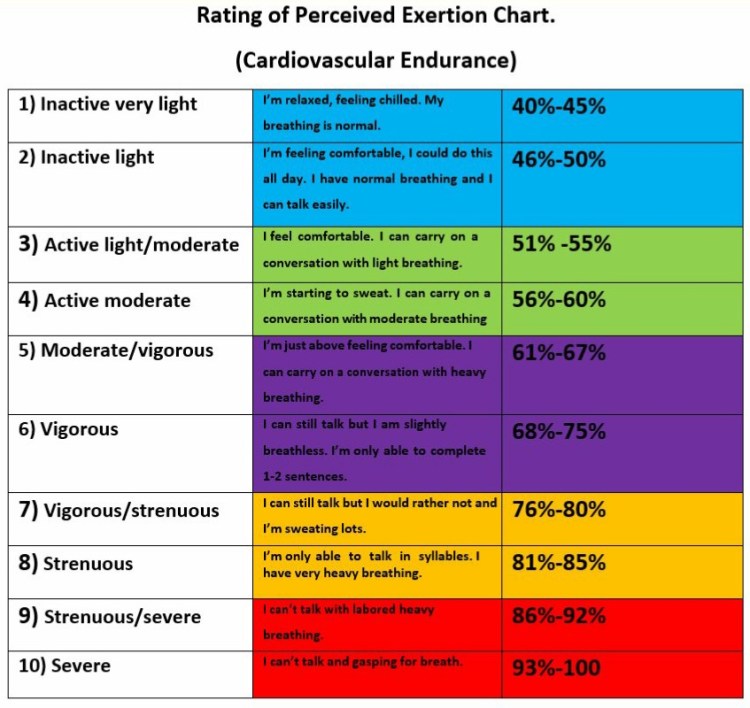
You can use the rate of perceived exertion scale (RPE) to determine your intensity level. The
scale runs from 1-10. One being very light activity (standing still) and 10 being max effort
activity. Max effort would feel almost impossible you would be completely out of breath.
Now to be safe you should only ever work around (7-8) unless you are an elite athlete with
professional support around you. (7-8) is Vigorous activity, borderline uncomfortable,
shortness of breath, it’s difficult and you will be pushing yourself.
This activity will vary depending on the individual’s fitness level, age etc. your heartrate should be around 75%-
85% of your maximum heartrate (MHR) or maximum minute power. It’s never been easier
to work this out with technological advances like the Fitbit, Apple and Garmin Watches.
To work it out manually. Minus your age from 220 and multiply it by the intensity you wish to work, for example: 220 – 40 = 180 x 0.80 = 144 (BPM). Always Remember if you are new to exercise proceed with caution. Moderate exercise an (RPE) of 4-5 and a (MHR) of 55%- 65% would be advised initially.
If you suffer from any medical condition or injury seek advise
from a qualified medical professional before you begin any new exercise regime.
Benefits of cardiovascular exercise:
• Decrease in body fat.
• Greater Stamina/ exercise tolerance.
• Reduction in low lipid dense cholesterol (bad).
• Increase in high lipid dense cholesterol (good).
• More efficient control of blood sugar levels, insulin sensitivity.
• Better mood.
• Healthy blood pressure



 Kelly and Tania's Fitness